Marshall Vincent D, Moustafa Farah, Hawkins Spencer D, Balkrishnan Rajesh, Feldman Steven R
College of Pharmacy, University of Michigan, Ann Arbor, MI, USA.
Department of Dermatology, Brown University, Providence, RI, USA.
Dermatol Ther (Heidelb). 2016 Dec;6(4):649-658. doi: 10.1007/s13555-016-0144-3. Epub 2016 Sep 22.
Inflammation is an established component of cardiovascular disease (CVD) and an underlying factor of several dermatologic conditions including rosacea, atopic dermatitis, and psoriasis. Identifying potential associations between these dermatologic and cardiovascular diseases can better inform holistic healthcare approaches. The objective of this study was to determine whether rosacea, psoriasis or atopic dermatitis are independent risk factors for CVD 1 year following diagnosis.
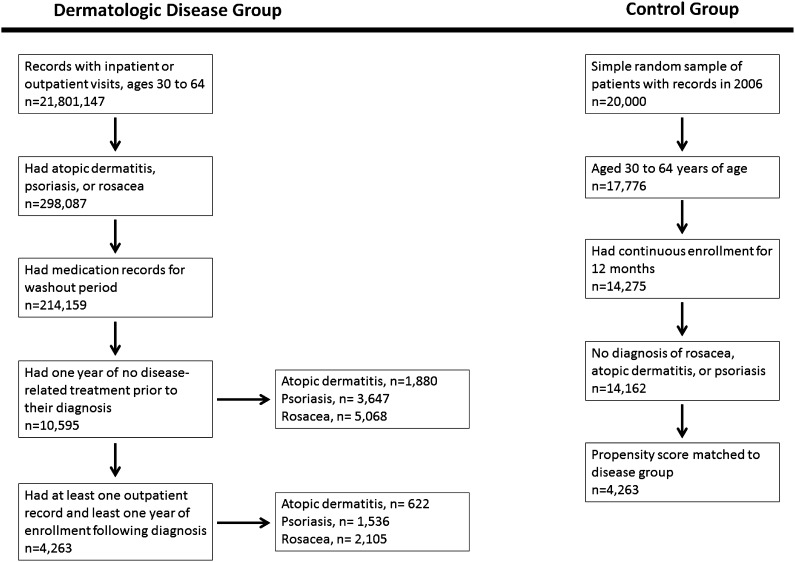
Using a large commercial claims database of 21,801,147 lives, we employed a propensity-matched logistic regression to evaluate the association between diagnoses of rosacea, psoriasis, or atopic dermatitis and a 1-year risk of being diagnosed with cardiovascular disease. Control patients were matched based on health-care utilization, age and overall health status as defined by a modified Deyo-Charlson comorbidity index.
The analysis included 2105 rosacea, 622 atopic dermatitis, 1536 psoriasis, and 4263 control patients. Compared to propensity-matched controls, the adjusted odds of cardiovascular disease were not higher in patients with rosacea (odds ratio: 0.894, p = 0.2713), atopic dermatitis (OR 1.032, p = 0.8489), or psoriasis (OR 1.087, p = 0.4210). In univariate analysis, the unadjusted odds of cardiovascular disease was higher in patients with psoriasis (OR 1.223, p = 0.0347).
Limitations of this study include the short follow-up period and inclusion of only commercially insured patients limit the generalizability of these findings. In this large study of patients with rosacea, atopic dermatitis, and psoriasis, we did not detect an increased 1-year risk of cardiovascular disease after adjusting for confounders.
炎症是心血管疾病(CVD)的一个既定组成部分,也是包括酒渣鼻、特应性皮炎和银屑病在内的几种皮肤病的潜在因素。确定这些皮肤病与心血管疾病之间的潜在关联可以更好地为整体医疗保健方法提供信息。本研究的目的是确定酒渣鼻、银屑病或特应性皮炎在诊断后1年是否为心血管疾病的独立危险因素。
利用一个包含21801147例患者的大型商业索赔数据库,我们采用倾向匹配逻辑回归来评估酒渣鼻、银屑病或特应性皮炎的诊断与1年内心血管疾病诊断风险之间的关联。根据医疗保健利用率、年龄和由改良的Deyo-Charlson合并症指数定义的总体健康状况对对照患者进行匹配。
分析包括2105例酒渣鼻患者、622例特应性皮炎患者、1536例银屑病患者和4263例对照患者。与倾向匹配的对照组相比,酒渣鼻患者(比值比:0.894,p = 0.2713)、特应性皮炎患者(OR 1.032,p = 0.8489)或银屑病患者(OR 1.087,p = 0.4210)发生心血管疾病的校正比值并不更高。在单因素分析中,银屑病患者发生心血管疾病的未校正比值较高(OR 1.223,p = 0.0347)。
本研究的局限性包括随访期短以及仅纳入商业保险患者限制了这些结果的普遍性。在这项对酒渣鼻、特应性皮炎和银屑病患者的大型研究中,我们在调整混杂因素后未发现心血管疾病1年风险增加。